
Nevada’s Data-Center Boom Is Outrunning Its Power Grid
By John Restrepo, Principal of RCG Economics and
Bob Potts, Former Deputy Director of the Nevada GOED
July 21, 2026
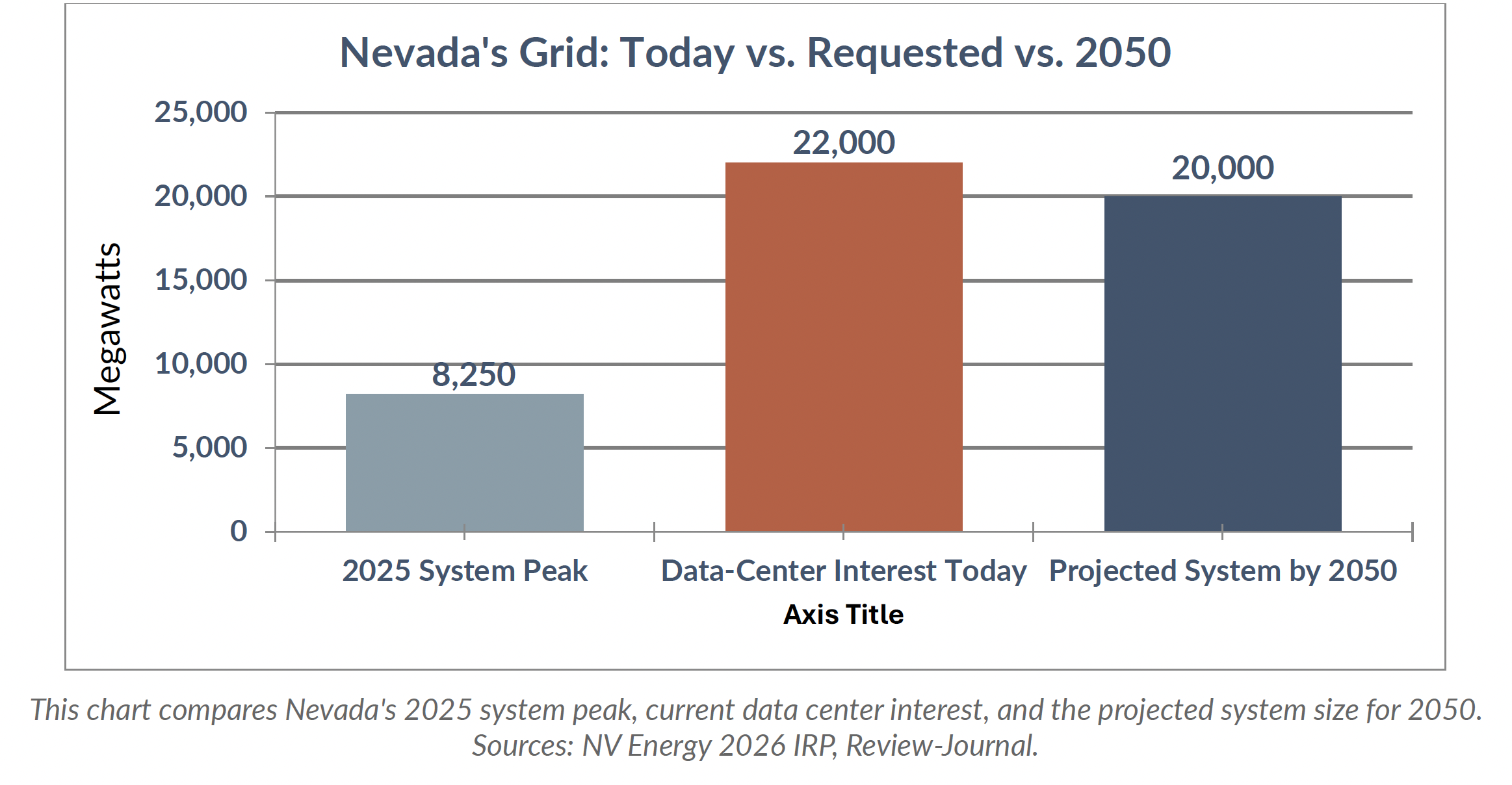
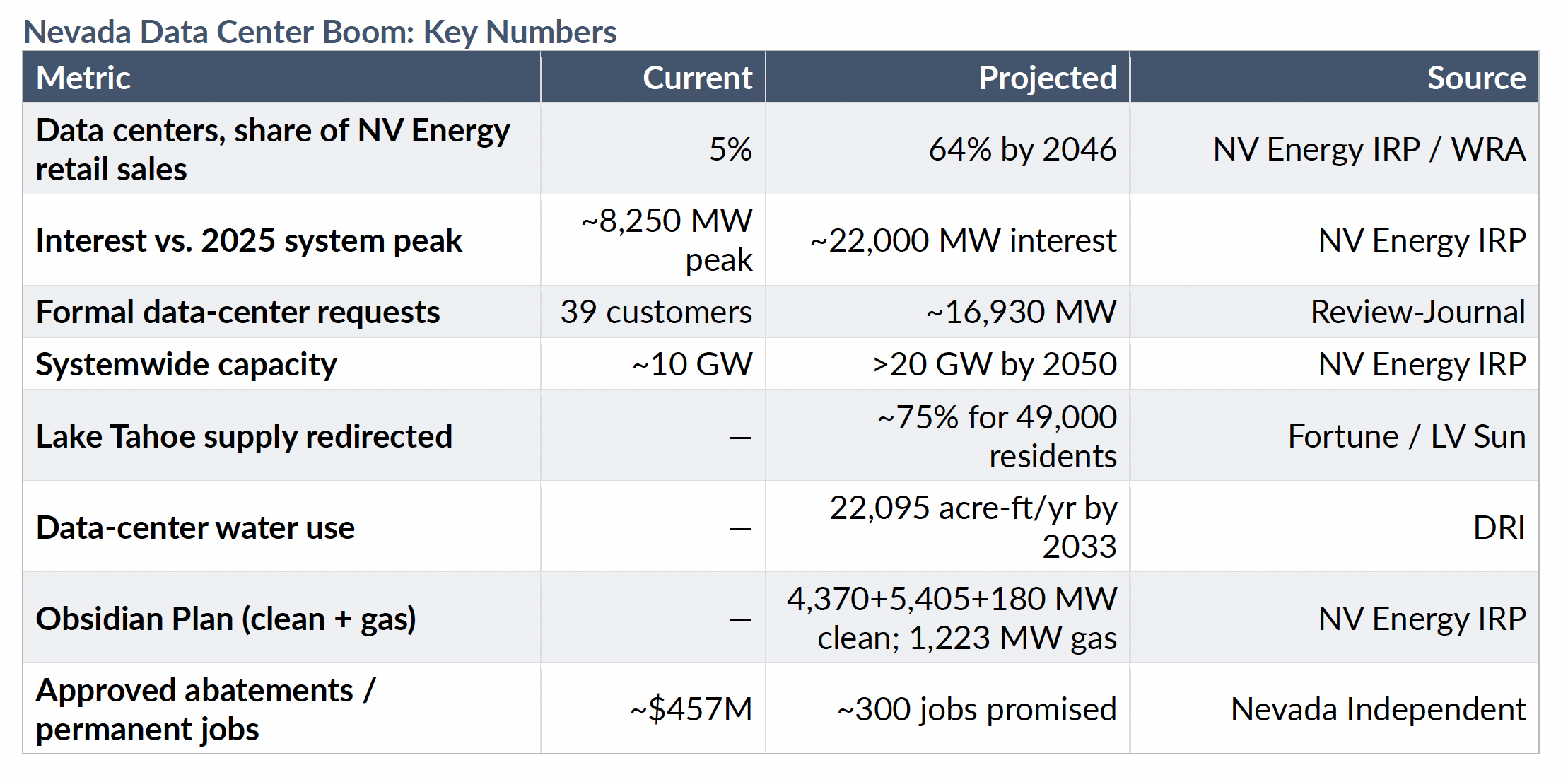
Nevada is now one of the fastest-growing data center markets in the country, and the math of that growth no longer fits the grid it runs on. In its 2026 Integrated Resource Plan, filed with state regulators in May, NV Energy reported roughly 22,000 megawatts of interest from data-center developers. That is nearly three times the two utilities’ combined 2025 system peak of nearly 8,250 megawatts. Formal requests from 39 prospective customers already total about 16,930 megawatts, most of it in the Northern Nevada. The utility has also signed some 6 gigawatts of interconnection agreements, roughly 84 percent of them with large-load customers in Northern Nevada. Reno-Sparks now ranks among the top emerging data-center markets in the world, with Google, Switch, Vantage, and Apple all active in the state. Put plainly: the load being requested is two to three times the size of the entire system that serves every household and business in Nevada today.
Data centers are about five percent of the utility’s retail sales today. NV Energy projects that they could reach 64 percent of sales by 2046. Meeting that demand would roughly double the capacity it has to supply, to more than 20,000 megawatts (20 gigawatts) by 2050. The utility has raised its own load forecast by 47 percent in just two years. That is not a tweak to a long-range plan. It is a step change in the size of the system, and it is arriving faster than conventional generation and transmission can be built. One megawatt powers roughly 750 homes, so the requested load, if it all showed up, would be several times the size of Nevada’s current residential-base.
The pressure is not unique to Nevada. Nationally, AI data centers are projected to roughly triple their share of U.S. electricity use, from about 4.4 percent in 2023 to as much as 12 percent by 2028, and they drove about half of all growth in U.S. electricity demand last year. A single large AI data center can consume as much electricity as 100,000 households, operating continuously throughout the year. In Nevada, the direction of the trend hasn’t changed. Its scale has. And it is now clear that the technologies used to power and cool these facilities will decide whether the growth can last.
When Data Centers Compete With Households
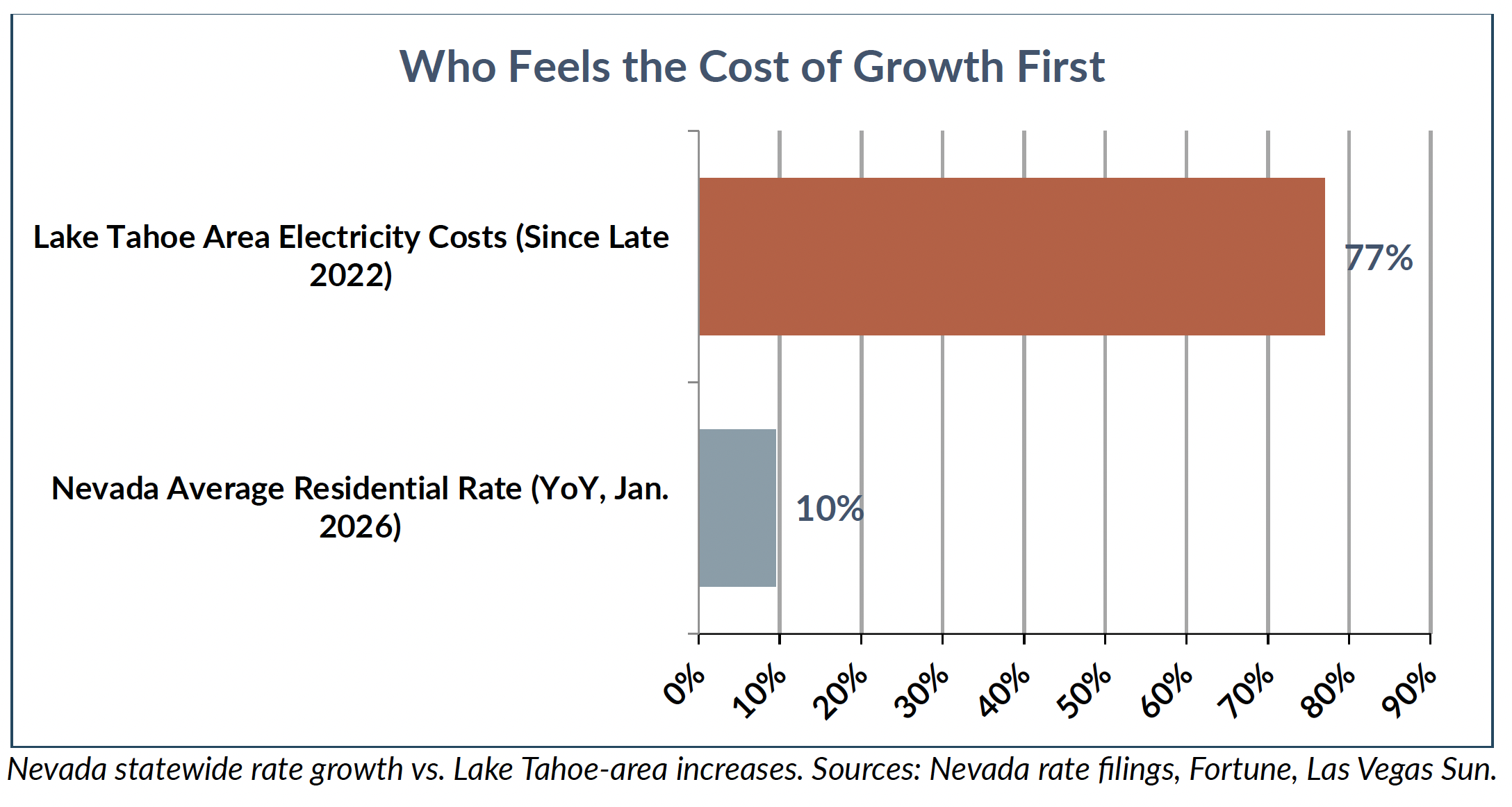
The strain already shows where supply is tightest. In May, NV Energy told Liberty Utilities it would stop providing roughly 75 percent of the electricity serving about 49,000 residents on the California side of Lake Tahoe by May 2027, redirecting that capacity toward data centers near the Tahoe-Reno Industrial Center. The California grid can’t easily serve those households, because their lines fall inside NV Energy’s balancing authority. Across the West, small residential customers increasingly find themselves bidding for power and transmission against hyperscale buyers with far deeper pockets. Nevada’s average residential rate reached $.14-$.15 per kilowatt-hour in January 2026. While national average residential rates rose by 9.5 percent from a year earlier, Nevada’s average residential rate stay relatively flat. This said, local ratepayers face growing pressure from newly implemented peak demand billing processes and multi-billion-dollar utility grid expansions.
Around Lake Tahoe, electricity costs have risen roughly 77 percent since late 2022. The core question the plan raises is cost allocation: does the price of the build-out land on the firms driving it, or on ordinary ratepayers? NV Energy has asked regulators to approve a large-load tariff meant to put more of those costs on the data centers themselves.
NV Energy’s Response and Its Trade-Offs
The utility’s answer is the Obsidian Plan, a request to approve 23 power-purchase agreements. It includes 4,370 megawatts of new solar and 5,405 megawatts of battery storage, the largest such expansion in the company’s history, plus 180 megawatts of geothermal. Alongside it comes 1,223 megawatts of new natural-gas capacity at the Fort Churchill station near Yerington. The plan builds on projects already approved in the 2024 IRP and now coming online, including the Libra Solar and Dry Lake East solar-and-storage facilities. The three-year capital budget runs to about $3.4 billion, concentrated heavily in the north. The trade-offs are real. The gas additions raise emissions, and the utility now expects to miss its renewable-portfolio standard for the first time, as early as 2027, because load is growing faster than clean supply can be added.
Water Is the Binding Constraint
Power is only part of the equation. In the Great Basin, water is often the tighter limit. The Desert Research Institute estimates that a dozen planned Northern Nevada projects, together roughly 5,900 megawatts of new demand and nearly three times Hoover Dam’s capacity, would consume about 22,095 acre-feet of water a year by 2033. This total is divided between the water used for direct cooling and the water used to generate electricity.
Data centers’ share of the state’s electricity generation could rise from 22 percent in 2024 to 35 percent by 2030, a broader gauge than their 5 percent of NV Energy’s current retail sales. This is why the cooling technology now reaching the market matters as much as generation. Microsoft’s sealed, closed-loop design avoids more than 125 million liters of water per data center each year. Immersion and direct-to-chip systems are scaling commercially, and Southern Nevada has already banned new evaporatively cooled buildings. In the arid West, waterless cooling has become the price of admission.
The Technologies That Could Close the Gap
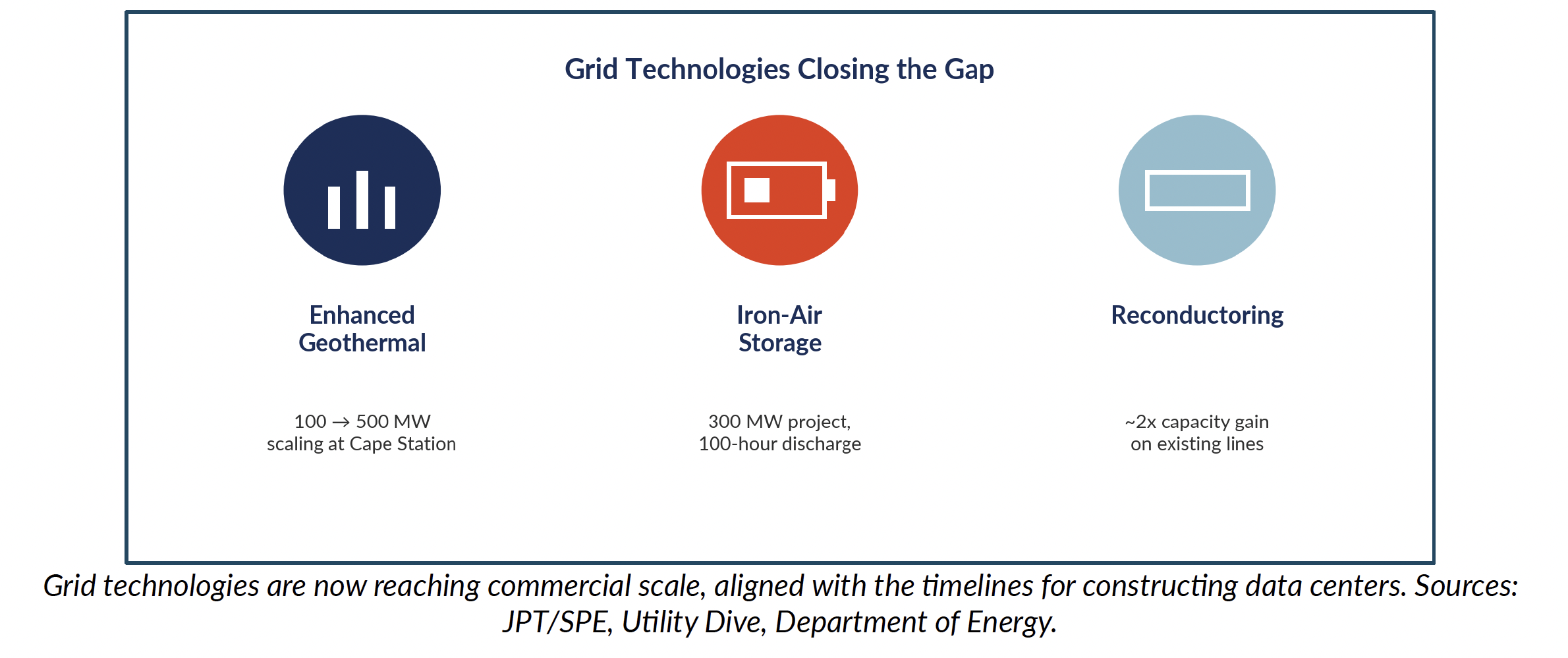
A parallel set of grid technologies is arriving on timelines that better match the pace of data-center construction.
- Enhanced geothermal is one. Fervo’s Cape Station in Utah is on track to scale from 100 to 500 megawatts, and it offers firm, around-the-clock, carbon-free power that fits a data center’s constant load. Fervo’s Project Red has supplied Google’s Nevada operations since 2023, and Google has signed a framework agreement for up to 3 gigawatts of geothermal capacity. In May 2026, Fervo raised about $1.89 billion in an initial public offering, a further sign that next-generation geothermal has moved from pilot to bankable infrastructure.
- Long-duration iron-air storage is another. The 300-megawatt Google-Xcel project announced in February can discharge for up to 100 hours, covering the multi-day lulls that four-hour lithium-ion batteries can’t.
- Replacing older, lower-capacity wires is a third. Restringing existing lines with advanced conductors can roughly double a corridor’s capacity within its current rights-of-way, a far faster path than building new transmission. One Nevada line was upgraded from about 300 to 1,000 amps this way. Federal money is flowing behind it, through the Department of Energy’s $1.9 billion SPARK program, launched in March.
What It Means for Nevada’s Economic Development Strategy
The data center boom is, at bottom, an economic-development strategy. After the Great Recession, Nevada set out to diversify beyond gaming and tourism. In 2015, the Legislature created generous tax abatements, up to 75 percent off personal property taxes and a sales tax rate as low as two percent, for as long as 20 years, to attract server farms. The first target was landing Switch. The case for it is real. Data centers bring billions in capital investment.
Google alone has committed more than $1 billion across two Nevada campuses. The construction boom has kept the building trades busy, with the electrical workers’ union reporting some 4,000 electricians in the field in Northern Nevada, about 80 percent of them on data center sites. The facilities broaden an industrial base long tied to visitor counts, and they give Nevada a foothold in the infrastructure of the AI economy.
But data centers are capital-intensive and light on operating labor. Nevada’s major abated projects promised only about 300 permanent jobs among them, and local governments have forgone more than $537 million in sales-tax revenue over eight years, while the state does not track whether the promised revenue and activity ever show up. The strategy delivers investment and diversification. It also concentrates scarce power, water, and public subsidy in a sector that employs relatively few people and, as the sections above show, shifts infrastructure costs onto existing ratepayers.
Other early movers, including Virginia, Georgia, and Washington, are now adding “off-ramps” to their programs. Nevada’s own review is already underway. In 2026, the Governor’s Office of Economic Development began assessing the abatement program, Governor Joe Lombardo’s office said it was engaged in discussions on changing the current structure, and the Reno City Council paused new data-center approvals as the issue moved onto the state’s 2026 ballots. The goal for Nevada is to keep the investment while tightening the rules: tie tax breaks to confirmed jobs and tax payments, require the water- and power-saving technologies described earlier, and split the costs of electricity and water so the benefits and the burdens are shared fairly.
Supporters of the strategy counter that each data center job supports several more across suppliers and services and that most of these facilities would not have been built in Nevada without the incentives. Both claims may well be true. The trouble is that, without better tracking of actual jobs, wages, and tax receipts, the state can’t say with confidence whether the bargain is paying off. That uncertainty, more than the incentives themselves, is what a sharper policy would address.
Over the past year, the technologies needed to close the gap have moved from concept to commercial deployment, and the West is building them first. They work. The key issue is the adoption of these technologies. Will industry, utilities, and regulators move fast enough and split the costs fairly enough to keep the boom from overwhelming the power and water systems that Nevada’s existing residents and businesses rely on? With the right terms, data centers can anchor a more diversified state economy. With the wrong ones, the state exports its electricity and water and imports comparatively few jobs. How Nevada and its neighbors handle this will shape data-center development across the West for the rest of the decade.
Contact Information
Contact: For more information or media inquiries, please contact RCG Economics’ John Restrepo at 702-967-3188 ext. 101 or via our website at www.rcgeconomics.com.
Share This Analysis
If you found this analysis valuable, please share it with Nevada policymakers, business leaders, and stakeholders. The more people understand the scope of this threat, the better Nevada can prepare.
Connect: X, Facebook, LinkedIn, Bluesky
Subscribe: Substack
Contact: jrestrepo@rcgecon.com
© 2026 RCG Economics. All rights reserved.

