
Homes, Hedge Funds & the Limits of Populist Housing Policy
By John Restrepo, Principal, RCG Economics August 4, 2026
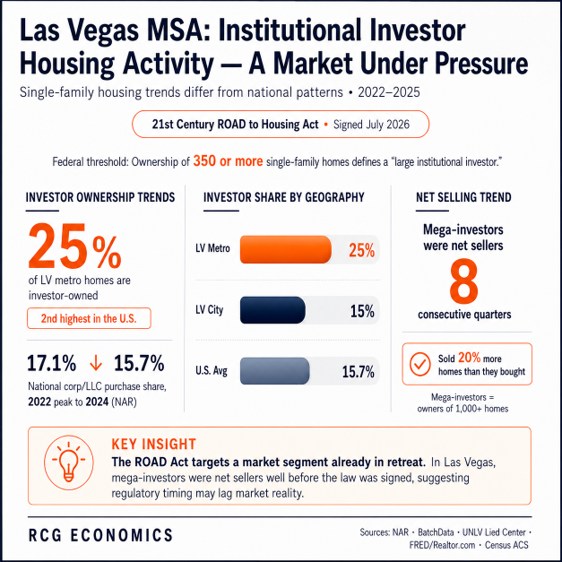
On July 11, 2026, the 21st Century ROAD to Housing Act became law without the president’s signature. The law bars large institutional investors—entities controlling 350 or more single-family homes—from purchasing additional properties, with limited exceptions. It is the most significant federal intervention in institutional single-family investment in modern American history, passed by the Senate 85–5 and the House 358–32 in their final votes in June 2026.
For an economist, the law raises a fundamental empirical question: Does restricting one class of buyer in a supply-constrained market improve affordability, or does it simply redistribute the burden? The populist appeal is clear. But the underlying economics are more complicated than either its champions or its critics acknowledge. This article looks at the evidence through the lens of supply and demand, market distortions, and the economic development stakes for Western states—with a particular focus on Nevada.
How Big Is the Problem, Really? Download the PDF to read more

